Reading
Reading at Swaffham Primary Academy
At Swaffham C of E Primary Academy, nothing is more important than making sure that every child can read fluently. We know that reading is fundamental to a child’s life as it allows them to learn, discover, explore and to connect to the culturally rich and diverse world that they belong to.
Ofsted June 2023:
'The teaching of reading is given high priority. Staff are well trained and deliver the school's chosen phonics scheme effectively. Children in Reception learn the basics of reading well. They are ready to develop their reading in Year 1. Pupils read books that allow them to practise the sounds they are learning. As a result, most are fluent readers by the end of Year 1.'
'Leaders ensure that pupils who struggle with their reading receive the right support to help them catch up.'
'There is a structured approach to teaching the more complex skills of reading.'
'Pupils talk enthusiastically about their favourite books and authors.'
'Fluency for us means every pupil will learn to read with accuracy, automaticity and with expression, emphasis, pause and tone. At Swaffham Primary Academy, reading is immersive within our environment and curriculum; we ensure that we provide dedicated teaching time to reading which involves sharing the love of books, decoding and comprehension. Through expert teaching, we will provide children with the phonics skills that they need to decode to become fluent, independent readers. Throughout our school, we broaden our students understanding of words and texts through our curriculum which centres around a rich and diverse set of texts, this includes the children who are learning to decode as they use whole class reading. These texts have been carefully selected to progressively challenge our children as they move through each year group. These texts will help to practise their comprehension skills and expose them to different experiences, uncover new language and vocabulary and to ask questions about the text. Additionally, our reading curriculum strives to equip each child with the components to become passionate readers and instil a love of reading for pleasure within them. We are committed to ensuring that we give the children time to read or be read to within the school day whilst promoting reading for pleasure through our ‘All About Words’ sessions. Furthermore, these sessions can be used to promote language and vocabulary. We believe that by giving every child these tools, they will shine as enthusiastic, confident, fluent and motivated readers at home and in school.
How do we teach reading at Swaffham Primary Academy?
Phonics
Intent
The intent of our phonics curriculum at Swaffham C of E Primary School is to ensure that all of our children can become fluent readers and writers. This is why we teach reading through Little Wandle Letters and Sounds Revised, which is a systematic synthetic phonics programme. We start teaching Little Wandle Foundations in our Nursery and then, from Reception, we follow the Little Wandle Letters and Sounds Revised progression, which ensures children build on their growing knowledge of the alphabetic code, mastering phonics to read and spell as they move through school. As a result, all our children are able to tackle any unfamiliar words as they read. At Swaffham C of E Primary School, we also model the application of the alphabetic code through phonics in shared reading and writing, both inside and outside of the phonics lesson and across the curriculum. We have a strong focus on language development for our children because we know that speaking and listening are crucial skills for reading and writing in all subjects. We value reading as a crucial life skill. By the time children leave us, they read confidently for meaning and regularly enjoy reading for pleasure. Our readers are equipped with the tools to tackle unfamiliar vocabulary. We encourage our children to see themselves as readers for both pleasure and purpose. As we believe teaching every child is so important, we have a Reading Leader who drives the early reading programme in our school. This person is highly skilled in teaching phonics and reading, and they monitor and support our reading team, so everyone teaches with fidelity to the Little Wandle and Sounds Revised programme.
Implementation
Foundations for Phonics in Nursery
- We provide a balance of child-led and adult-led experiences for all children that meet the curriculum expectations for 'Communication and Language' and 'Literacy'. These include:
- Sharing high-quality stories and poems
- learning a range of nursery rhymes and action rhymes
- activities that develop focused listening and attention, including oral blending
- attention to high-quality language.
- We ensure Nursery children are well prepared to begin learning grapheme-phoneme correspondences (GPCs) and blending in Reception.
- Little Wandle Foundations is aligned to the non-statutory guidance on Development Matters and Birth to 5 Matters as well as the Early Years Foundation Stage (EYFS) statutory framework. We use it as part of our wider provision for Communication and Language, and Literacy. It supports children to:
- develop their phonological awareness, including rhyme, alliteration, syllables, initial and voice sounds, and oral blending.
- love stories and rhymes, and learn by heart a bank of familiar favourites
- increase their vocabulary and confidence to talk
- improve their listening and ability to take part in back-and-forth conversations.
- We believe that the priority in Nursery should be to build the foundations for phonics for all children. Research tells us that disadvantages children start Nursery behind their more fortunate peers. By leaving formal phonics teaching to Reception, Foundations allows us to devote more time to working with children who need extra help to develop the skills and behaviours that underpin successful reading.
Daily Phonics lessons in Reception and Year 1
We teach phonics for 30 minutes a day. In Reception, we build from 10-minute lessons, with additional daily oral blending games, to full-length lessons as quickly as possible. Every Friday, we review the week's teaching to help children become fluent readers. Children make a strong start in Reception as teaching begins in Week 2 of the Autumn term. We follow the Little Wandle Letters and Sounds Revised expectations of progress:
- Children in Reception are taught to read and spell words using Phase 2 and 3 GPCs, and words with adjacent consonants (Phase 4) with fluency and accuracy.
- Children in Year 1 review Phase 3 and 4 and are taught to read and spell words using Phase 5 GPCs with fluency and accuracy.
Daily Keep-up lessons ensure every child learns to read.
Any child in Reception and Year 1 who needs additional practice has Daily Keep-up support and is taught by a fully trained adult. Daily Keep-up lessons follow the Little Wandle progression and use the same procedures, resources and mantras, but in smaller steps with more repetition so that every child secures their learning.
Daily phonics and spelling in Year 2
Year 2 begins by using assessment to ensure that children have completed the Little Wandle Year 1 progression. Any gaps in teaching are addressed through daily phonics lessons until the programme is completed. Corresponding summative assessments are carried out to ensure this content is secure. Once all Year 1 content has been taught and assessed, we teach a five-week Phase 5 review. This ensures that children secure the trickier elements of Phase 5 and can apply this alphabetic knowledge in both reading and spelling. We use the Phase 5 reviee assessment before teaching in Year 2 to identify any children who may need more support when teaching. We reassess after teaching the Phase 5 review.
Teaching reading: Reading practice sessions.
We teach reading practice sessions three times a week. These sessions are taught by a fully trained adult to small groups. The books that are used are matched to the children's secure phonic knowledge using the Little Wandle Letters and Sounds Revised assessments and book matching grids. Additionally, they are monitored by the class teacher, who rotates and works with each group on a regular basis. Each reading practice session has a clear focus, so that the demands of the session do not overload the children's working memory. The reading practice sessions have been designed to focus on three key reading skills:
- decoding: teaching children to use phonic knowledge to read words.
- prosody: teaching children to read with understanding and expression.
- comprehension: using dialogic talk to help children to understand the text.
In Reception, these sessions start in week 4 of teaching at the latest. Initially, children will read wordless books. In these sessions, children review GPCs and are taught blending using teacher-led blending. Once children can blend, they progress onto decodable books matched to their secure phonic knowledge. Children read each book, three times to develop phonemic awareness, vocabulary and comprehension as well as book behaviours. At the end of each week, the decodable reading practice book is taken home to ensure success is shared with their family.
Assessment
Assessment is used to monitor and progress and to identify any child needing additional support as soon as they need it.
- Assessment for Learning (AfL) is used daily within class to identify children who require Daily Keep-up support, as well as words and GPCs that need additional teaching. Furthermore, it is used to plan repeated practice throughout the day to ensure all children secure learning and weekly within the Friday review lessons to assess gaps, address these immediately and secure fluency of GPCs, words and spellings.
- Summative assessments are uploaded onto the assessment tracker for Reception and Year 1. These are used to generate visual reports (pupil heatmap, pupil trends and book levels, an a summary analysis) for individual children and classes.
- We assess the children every six weeks to assess progress and to identify gaps in learning that need to be reviewed or retaught, to establish if learning is secure for more than 70% of children before new content is taught and to identify any children needing additional support and to plan the Daily Keep-up support that they need. We reassess the children every 3 weeks if they are not on track.
Reading Books and Reading Rambles
All of our students are given a home reading book that they can take home to read. This year, we have introduced Reading Rambles as an exciting way to engage the children with what they have been reading. Our Reading Rambles contain exciting challenges that are updated each half term for the children to complete based on their reading. These activities are to help encourage children’s confidence, fluency and comprehension skills with reading. It also gives adults at home the opportunity to communicate with school about conversations they have had around reading, sounds or words that they may have found challenging. School staff will also have the opportunity to listen to children read and communicate with home about their reading. We have found that our Reading Rambles have engaged the children to want to talk about reading and has made a fantastic connection with home. Reading Rambles should be brought into school daily so we can see all of the brilliant work that the children have been doing around their reading.
In Reception and Year 1, all children are given a Jolly Phonic decodable reading book which matches the phonics stage that they are currently working at. It is important that the children are reading books that match the phonetic sounds that they have already learnt and know as it help to consolidate their learning and ensure fluency with their phonemes. Every child will take home a reading book that matches the phonemes that they have been learning in class as well as reading decodable Jolly Phonics books to an adult at school. Ultimately, this will help with our vision and belief of creating enthusiastic, confident and motivated readers before moving them on to more challenging texts. From Year 2, children who are still needing support with their reading will be given a home reading book that is linked to their reading age. Once the children have displayed that they are reading fluently and no longer need the support of reading banded books, the children will become ‘free readers’ and will begin to choose their own reading books, either books that are available in the reading corners, school library or their reading books that they have from home.
Supporting reading
How do we teach comprehension at Swaffham Primary Academy?
Our intent for teaching comprehension at Swaffham Primary Academy is to allow our students to gain experiences from high-quality texts that have been selected carefully to link to our curriculum. To develop our student’s comprehension skills, we use Reading Masters which is a programme to support vocabulary and comprehension. Throughout Reading Masters, our students are exposed to a range of fiction, non-fiction and poetry texts which are read as a whole class and encourages them to read widely to increase their understanding and use of vocabulary and language. Our Reading Masters lessons, allow children to practise a range of reading domain skills through discussion, working in groups and individual work.
Reading Masters
Reception and Year 1
In Reception, one twenty-minute Reading Masters session will take place once a week. This involves sharing a book during whole class story time where new vocabulary will be introduced to the children. The practising and development of reading comprehension skills will take place during discussion. Reading Masters in the Early Years is focused on teaching and developing the comprehension skills applied in Key Stage 1
- Vocabulary; we learn new words and their meanings.
- Inference; we can infer how character’s might be feeling and why.
- Predict; we predict what a book may be about based on the title and front cover, and make predictions about what we think will happen next.
- Sequence or summarise; we can retell stories, sequence texts and summarise what happened.
In Year 1, the children will continue with this structure of whole class reading and discussion to develop their comprehension skills whilst also using carousel activities to support discussion and expressing their ideas and thoughts around the text. In the Spring term, the children will start to move towards the structure of Reading Masters that takes place from Year 2 onwards.
Year 2 – 6
Whole class sessions take place four times a week in a twenty-minute session. During these sessions, children will read a range of fiction, non-fiction and poetry. All children will have access to the text/extract and carefully planned activities will be used to support their comprehension skills. During Reading Masters, the first lesson will focus on the context and meaning of the text. Teachers will give the children any background knowledge or new vocabulary that they will need to support their learning before they read the text as this allows them to have a full understanding before being given the text/extract themselves. The teacher will read through the text, at least twice, in which they will model fluency (the ability to read with speed, accuracy and expression) and prosody for meaning (the expression in reading). After this, classes will have time for discussion about the content, vocabulary or grammar that the children will need to have a deeper understanding of the text.
Children will practise different reading skills throughout these sessions and they will vary depending on the text type or skills that they need support and practise with.
These skills are:
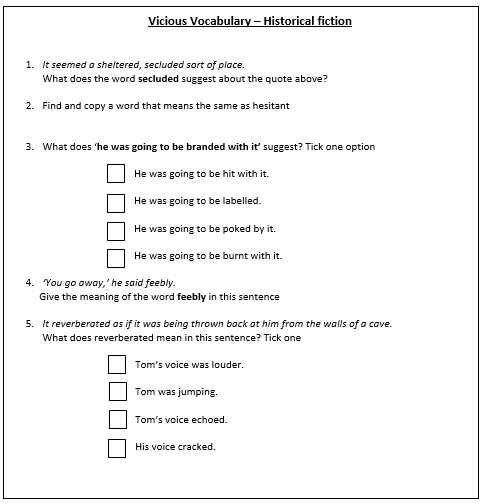
- Vocabulary (Vicious Vocabulary)
- Retrieval (Radiant Retrieval)
- Summary (Sneaky Summary)
- Inference (Incredible Inference)
- Prediction (Peaceful Prediction)
- Meaning (Magical Meaning)
- Comparison (Calamitous Comparison)
- Fluency (Friendly Fluency)
These reading domains will cover a range of question types: different question stems; open and closed questions; tables; matching items; missing sections; multiple choice; ranking; find and copy and labelling.
How do we instil a love of reading within our students at Swaffham Primary Academy?
At Swaffham Primary Academy, we want every child to become confident readers and instil a love of reading and reading for pleasure within them. We make reading a priority within our school and ensure that we provide the time and provision for children to spend time and enjoy reading. As a school, we promote a range of fiction, non-fiction and poetry for our students to immerse themselves in and to allow their imaginations to wonder and be filled with wonderful thoughts and adventures. Our school knows the importance of being able to recommend books, share ideas and being able to encourage others to try something new. At Swaffham Primary Academy, we use a range of activities to showcase reading for pleasure and reading for enjoyment.
Reading areas and celebrating reading
Every classroom within Swaffham Primary Academy has their own reading area where the children have the opportunity to read and select books. Each classrooms reading area will be unique to their class and the children have the opportunity to take ownerships of what they want to include on their bookshelves. Each half term, the children will be given the opportunity to go to the library to browse through the books and take a selection that they would like to have in their classroom. This allows children to have a collection that they have personally chosen and encourages them to read for enjoyment. The library is overseen by Miss Purple and Mrs O'Connell who makes sure that the library is kept up to date with the latest texts and organises a time table for the library to be visited by each class. Moreover, in Early Years and Year 1, there is an additional library space that children can access as part of their everyday provision; we have a wide range of books to explore including picture books, classic traditional tales, texts to support PSHE, early understanding and exploration of Religious Education as well as books relating to our curriculum and Dimensions themes. The EYFs and KS1 library area is an integral part of their daily provision that demonstrates the importance and wonder of reading from the children’s very first day at school.
At Swaffham Primary Academy, we also take the time out to celebrate reading and authors across the school. This year, the whole school took part in World Book Day. Every class did work around a particular book called 'The Barnabus Project'. Each class read the book and then completed work around the book and the characters within the book. Children created their own 'Perfect Pets' or 'Failed Projects', discussed the themes within the book and wrote their own stories around the characters or their own characters. Additionally, the children came dressed as their favourite book character and took part in additional reading activities throughout the week. Each child went home with a World Book Day £1 voucher so they could choose their own book.
On Friday 24th March 2023, Swaffham Primary Academy had a visit from award-winning author Nigel Lungenmuss- Ward. He came to talk to the children about what being an author has like, why reading was so important and they could achieve anything that they wanted to achieve. Nigel wrote his debut book called 'Freddie's Impossible Dream' and his eight-year old son illustrated the book with him as well as to promote reading, Nigel inspired the children that they would be able to achieve anything that they put their mind to. After reading stories to Reception, Nigel delivered a KS2 assembly where he spoke about his journey to be an author, his inspiration and set the children a writing task based on a character in the book. He visited each KS2 class and spent time hearing their ideas for their stories and answering any questions. In the afternoon, Nigel delivered an assembly to KS1 and then spent time in each KS1 classroom where they completed activities based on what their dreams were for when they were older. He finished the day off by holding a book sale for the children and parents to attend.
World Book Day 2023


World Book Day 2022


Nigel Lungenmass-Ward (Author Visit 24.03.23)


Reading in our local community
This year, we have set up connections with our local community to promote reading. We have been working closely with the local high school (The Nicholas Hamond Academy) to promote reading. During National Story Telling Week, 30th January 2023 - 5th February 2023, students from the high school came across to read stories to our Reception and Year 2 classes. Our Year 2 class (Water Voles) really enjoyed it and would love to do it again.
A child from the high school stated, 'When I went to Swaffham Primary Academy, I felt extremely happy to be back. It made me feel really special and appreciated when the children listen to me reading Maccas' Makeover. Overall, it was really fun and I enjoyed it.'
During World Book Week 2023, our Year Six classes went over the high school's Learning Resource Centre and took part in a book scavenger hunt! The children took part in activities to get to know what texts were available in the LRC and find books that they would be interested in. The children really enjoyed the experience and seeing the range of resources that were available in the library!


